 Arcora Wasserhahn

What’s the Best Bathroom Sink Faucet for Hard Water in 2026?
Ansichten:0 EinstufungCompare
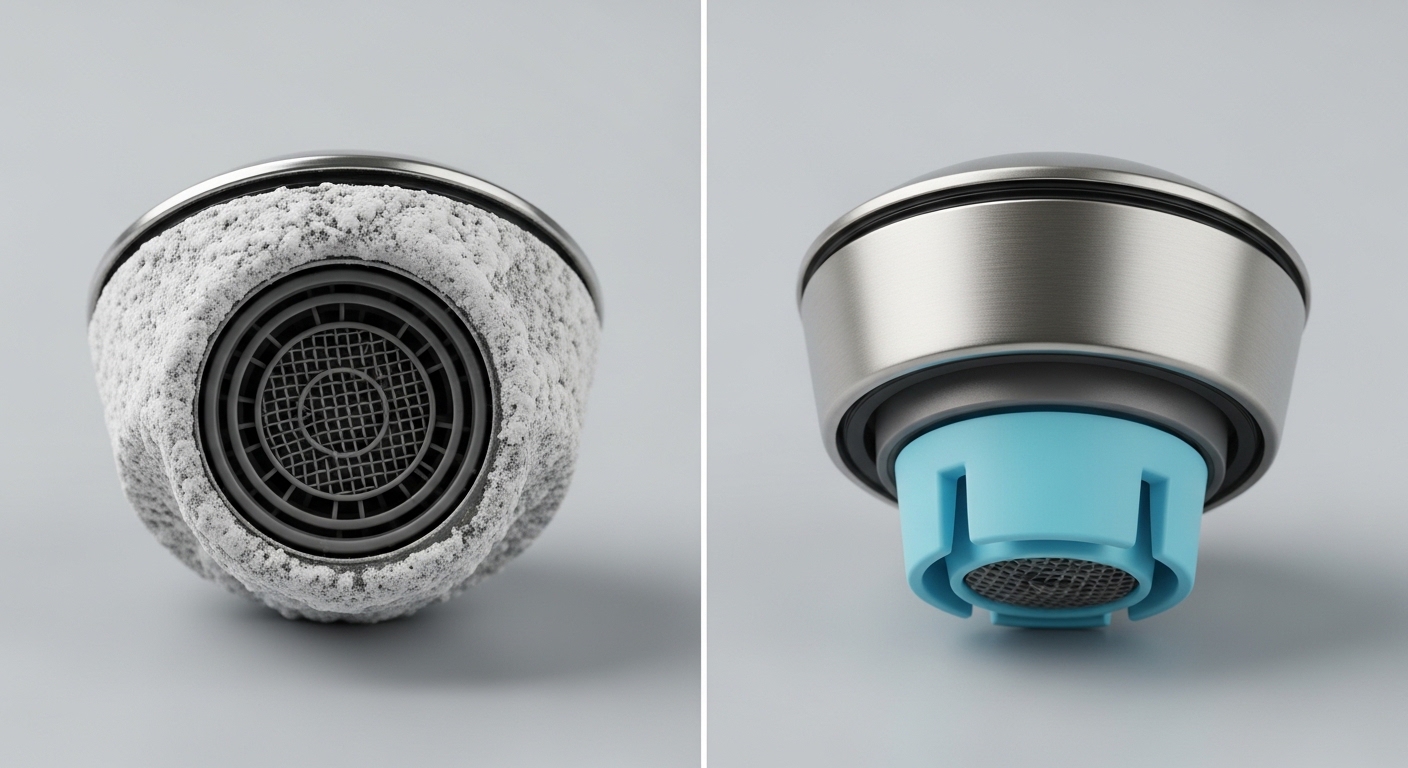
If you’ve been searching for the best bathroom sink faucet for hard water, the honest answer is that the faucet body matters far less than three specific parts: the valve (cartridge), the finish, and the aerator. Hard water — water loaded with dissolved calcium and magnesium — doesn’t attack a faucet evenly. It clogs the aerator, chalks up the finish with white spots, and slowly grinds down cheap valves until they drip. Pick a faucet that’s engineered against those three failure points and it’ll outlast a „premium“ faucet that ignored them. Below, we’ll walk through exactly what to look for, compare finishes and valve types head to head, and answer the real questions people ask before they buy.
Why does hard water ruin bathroom faucets so fast?
Hard water ruins faucets by leaving mineral deposits — mostly calcium carbonate — everywhere the water touches and evaporates. When a droplet dries on your spout, the water leaves; the minerals don’t. Over weeks that builds into the chalky white crust (limescale) you see around the base and on the aerator screen.
Here’s what’s actually happening in the three danger zones:
- The aerator — the little mesh screen at the tip of the spout. Minerals collect in its tiny holes and choke the flow, which is why a hard-water faucet slowly goes from a strong stream to a weak, splitting trickle within a year.
- The finish — polished chrome shows every water spot; a rougher, spot-resistant finish hides them. Hard water doesn’t damage a good finish, but it makes a shiny one look permanently dirty.
- The valve (cartridge) — the part that starts and stops the water. Grit and mineral scale act like sandpaper on a cheap rubber-washer or plastic valve, causing the drips and stiff handles that make people replace faucets years too early.
Water hardness is measured in grains per gallon (gpg). Anything above 7 gpg is „hard,“ and above 10 gpg is „very hard“ — where these problems accelerate. If you’re already fighting weak flow, our guide on faucet low water pressure shows how a scaled aerator is usually the first culprit, not your plumbing.
What faucet valve type holds up best against hard water?
A ceramic-disc cartridge is the best valve type for hard water — it uses two polished ceramic plates that slide against each other, and ceramic is far too hard for mineral grit to scratch. That’s why ceramic-disc faucets keep a crisp on/off feel and stay drip-free for years in mineral-heavy water, while older valve designs wear out.
Here’s how the common valve types stack up when the water is hard:
| Valve type | Hard-water durability | Typical lifespan (hard water) | Best for |
|---|---|---|---|
| Ceramic disc | Excellent | 15–25+ years | Anyone with hard water — the default choice |
| Cartridge (brass/stainless) | Good | 10–15 years | Mid-range budgets; easy to replace |
| Ball valve | Fair | 5–10 years | Older single-handle designs; more parts to fail |
| Compression (rubber washer) | Poor | 2–5 years | Cheap two-handle faucets; avoid for hard water |
The practical takeaway: read the spec sheet and look for the words „ceramic disc cartridge.“ Bonus points if the manufacturer sells the cartridge as a replacement part — that means the whole faucet is designed to be serviced, not thrown away, when a valve finally wears.
Which finish resists hard water spots — brushed nickel, matte black, or chrome?
Brushed nickel and matte black hide hard-water spots best; polished chrome shows them worst. The reason is simple: a brushed or matte texture scatters light and breaks up the outline of a dried mineral spot, while a mirror-polished surface reflects it straight at your eye. If your bathroom water is hard and you don’t want to wipe the faucet daily, choose a textured, „spot-resistant“ finish.
| Finish | Hides water spots? | Cleaning effort | Notes |
|---|---|---|---|
| Brushed / satin nickel | Excellent | Low | Warm tone; the top all-around hard-water pick |
| Matte black | Very good | Low–medium | Hides spots, but dried white scale can show as a light film |
| Brushed gold / champagne bronze | Very good | Low | Textured versions hide spots well |
| Polished chrome | Poor | High | Cheapest and toughest coating, but shows every spot |
One nuance on matte black: it hides the shine of water spots beautifully, but heavy, dried limescale can leave a faint white haze that’s more visible than on nickel. A quick wipe after the last use of the night handles it. If you’re weighing that look, our breakdown of a matte black widespread faucet setup covers the day-to-day upkeep in more detail.
Does the faucet material matter — is solid brass really worth it for hard water?
Yes — solid brass is worth it for hard water because it resists internal corrosion and the pitting that mineral-rich water accelerates in cheaper metals. Many bargain faucets use zinc alloy (sometimes labeled „zamak“) or thin pot metal under the plating; hard water and the trapped moisture around a sink speed up corrosion inside those bodies, which eventually shows as flaking finish and weeping leaks at the base.
How to tell what you’re actually buying:
- Weight — pick the faucet up. Solid brass feels noticeably heavy and dense; zinc-alloy feels light and hollow.
- The spec line — look for „solid brass construction“ or „lead-free brass.“ Vague phrasing like „premium metal“ or „stainless finish“ usually hides an alloy body.
- Lead-free certification — a faucet certified to NSF/ANSI 61 and 372 (lead-free) is almost always brass or stainless, and it’s the standard you want for anything that dispenses drinking water.
Stainless steel is an excellent alternative to brass — naturally corrosion-resistant and lead-free — and it pairs well with a matching stainless bathroom look. The point is to avoid a plated zinc body if your water is hard, because that’s the material most likely to fail from the inside out.
What’s the best faucet configuration for a hard-water bathroom — single-hole or widespread?
For hard water specifically, a single-handle single-hole faucet is the easiest to live with because it has one cartridge and one spout to descale — fewer parts means fewer places for mineral buildup to cause leaks. A widespread or centerset faucet looks more traditional and gives you two handles, but that’s two valve seats that can scale up and drip.
That said, configuration is mostly driven by your sink’s drilled holes, so match the faucet to the sink first:
- Single-hole — one handle, one cartridge, simplest to clean and service. Best for minimalist vanities and the lowest-maintenance choice in hard water.
- Centerset (4-inch) — handles and spout on one base plate, common on standard three-hole sinks. If you like two handles, cross-handle versions are easy to grip even with wet hands.
- Widespread (8-inch) — separate handles and spout for a high-end look, but the most connection points to keep scale-free.
If you’re leaning toward a classic two-handle look, our guide to centerset bathroom faucet cross handles explains why cross handles are a smart, grippy choice — and for a full three-hole widespread install, the ultimate guide to 3-hole brushed nickel bathroom fixtures covers the layout and spacing you’ll need.
How do you stop hard water from wrecking a new faucet?
The single most effective habit is to unscrew and soak the aerator in white vinegar every one to two months — that alone prevents 80% of the flow and spotting problems people blame on the faucet itself. Hard water is manageable; you just have to give the minerals somewhere to go besides your fixtures.
A realistic maintenance routine looks like this:
- Wipe the faucet dry after the last use of the night. Thirty seconds with a soft cloth stops spots before they form.
- Descale the aerator every 4–8 weeks. Unscrew it, soak the parts in white vinegar for an hour, brush the screen with an old toothbrush, and reinstall. Choose a faucet with a removable or silicone (rubber-nub) aerator to make this painless.
- Never use abrasive pads or acidic bathroom cleaners on the finish. They dull spot-resistant coatings. Warm soapy water and a soft cloth are all a good finish needs.
- Consider a whole-house or point-of-use softener if your water tests above 10 gpg. It’s the only fix that treats the cause instead of the symptom, and it protects your water heater and shower fixtures too.
If your flow has already dropped off, don’t assume the faucet is failing — a clogged aerator mimics a plumbing problem. The same diagnostic steps in our low-flow kitchen faucet fix apply directly to a bathroom sink faucet, since the aerator is identical in principle.
What should you actually budget for a good hard-water bathroom faucet?
Plan on $80–$180 for a faucet that genuinely survives hard water — a solid-brass or stainless body, ceramic-disc cartridge, spot-resistant finish, and a real warranty. Below about $50 you’re usually getting a zinc body with a compression or basic ball valve, which is exactly the combination hard water eats through fastest. Above $200 you’re mostly paying for design and brand, not extra durability.
Here’s how the price tiers usually break down:
| Price range | What you typically get | Hard-water verdict |
|---|---|---|
| Under $50 | Zinc body, compression/ball valve, polished chrome | Skip — short lifespan, shows every spot |
| $80–$180 | Solid brass/stainless, ceramic disc, spot-resistant finish, warranty | The sweet spot — best value for hard water |
| $200+ | Designer finishes, premium branding, same core internals | Fine, but you’re paying for looks, not durability |
The value logic is simple: the parts that resist hard water — ceramic disc, brass body, spot-resistant finish — are all present by the mid tier. Spending more buys aesthetics, not longevity.
Author note & why trust this guide
Written by the arcorawasserhahn product team. arcorawasserhahn (arcorawasserhahn.de) has specialized in faucets and bathroom fixtures for over a decade, and we’ve handled thousands of customer questions specifically about hard-water spotting, scale, and cartridge wear across German and international water conditions. Our recommendations here reflect that field experience plus the same industry benchmarks reputable manufacturers test against.
On the standards that matter: look for faucets certified to NSF/ANSI 61 and 372 (safe, lead-free wetted parts) and, where flow efficiency is claimed, WaterSense labeling (1.2 gpm or less at the aerator without a weak feel). Faucet cartridges are typically validated for hundreds of thousands of open/close cycles, and a manufacturer confident in its valve will back it with a limited lifetime warranty on the cartridge and finish — that warranty is your single best signal that a faucet is built to survive hard water. If a listing won’t tell you the valve type or the warranty length, treat that silence as an answer.
FAQ
Does hard water actually damage the faucet, or just make it look dirty?
Both. On the surface, hard water leaves white spots and film that make a finish look permanently dirty. Internally, mineral grit wears down cheaper valves and clogs the aerator, which reduces flow and eventually causes drips. A ceramic-disc, solid-brass faucet resists the internal damage; a spot-resistant finish handles the cosmetic side.
Is brushed nickel or matte black better for hard water?
Both hide water spots far better than polished chrome, so either is a strong hard-water choice. Brushed nickel is slightly more forgiving because dried limescale can leave a faint white haze on matte black that’s a bit more visible. Nickel is the safest low-maintenance pick; matte black is fine if you wipe it down regularly.
Will a water softener let me use any faucet I want?
Largely, yes. A whole-house softener removes the calcium and magnesium that cause spotting and scale, so even polished chrome stays clean and cheaper valves last longer. It’s the only solution that treats the root cause. Even so, a ceramic-disc cartridge is worth choosing anyway for its smooth, long-lasting feel.
How often should I clean the aerator on a hard-water bathroom faucet?
Every 4–8 weeks in hard water. Unscrew the aerator, soak the parts in white vinegar for about an hour, scrub the screen with an old toothbrush, rinse, and reinstall. If your flow drops noticeably sooner than that, your water is on the harder end and you may want to descale monthly or add a softener.
Are expensive faucets more resistant to hard water than mid-priced ones?
Not necessarily. The features that fight hard water — a ceramic-disc cartridge, solid-brass or stainless body, and a spot-resistant finish — are all present in the $80–$180 range. Above $200 you’re mostly paying for designer looks and branding, not better hard-water durability. Match the spec sheet, not the price tag.
Can hard water void my faucet warranty?
Mineral buildup itself usually doesn’t void a warranty, but neglect can. Most manufacturers require reasonable maintenance — like periodic aerator cleaning — and won’t cover damage from harsh acidic cleaners or abrasive pads on the finish. Keep your receipt, follow the care instructions, and a limited lifetime cartridge/finish warranty will typically still apply.
您好!Bitte einloggen