 Arcora Wasserhahn

Why Is My Water Trickling, and How Do You Fix Low Flow Kitchen Faucet Problems Fast?
Ansichten:0 EinstufungFaq
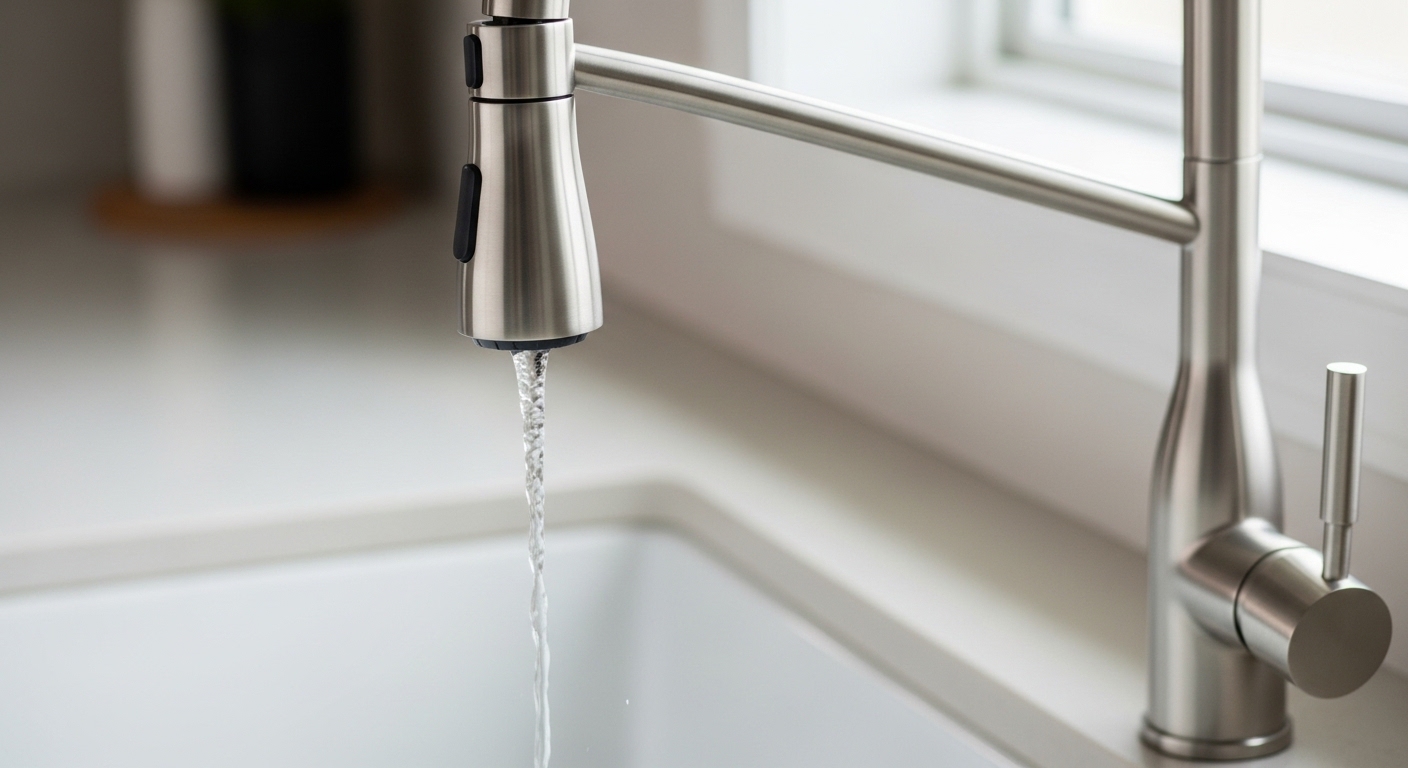
If you want to fix low flow kitchen faucet trouble without paying for a service call, the good news is that the fix is usually cheap, fast, and doesn’t require touching the plumbing inside your wall. A kitchen faucet that suddenly went from a strong stream to a sad dribble is almost never „broken“ in the expensive sense — it’s clogged, and clogs happen in a handful of predictable spots. This guide walks you through each spot in the order a professional plumber would actually check them, so you find the blockage in the first 15 minutes instead of the last.
We’ll cover how to diagnose whether the problem is the faucet or your home’s water supply, the exact parts that clog, a step-by-step cleaning method, when hard water is the real villain, and when it’s finally time to replace a part. Every section leads with the direct answer, then explains the why.
How do I know if the low flow is the faucet or my whole house?
Turn on a different faucet — the bathroom sink or the tub. If the water pressure there is strong and only your kitchen faucet is weak, the problem is inside your kitchen faucet (aerator, spray head, or under-sink valves). If every faucet in the house is weak, the problem is your home’s water supply, pressure regulator, or main shut-off, and it’s a different job entirely.
This 30-second test saves you from disassembling a faucet that was never the problem. Here’s how to read the result:
- Only the kitchen faucet is weak → clogged aerator, spray head, or supply-side valve. Keep reading — this is what this guide fixes.
- Only the hot side is weak → sediment from your water heater, or a partially closed hot shut-off valve under the sink.
- The whole house is weak → your pressure regulator, main valve, or municipal supply. That’s a whole-home diagnosis; our companion guide on faucet low water pressure across kitchen and bathroom fixtures walks through the house-wide causes step by step.
One more quick check: does the flow start strong and then fade after a few seconds, or is it weak the moment you turn it on? A flow that fades usually points to a clogging aerator or a failing cartridge; a flow that’s weak from the first drop points to a supply valve that isn’t fully open or a kinked line.
How do you clean a kitchen faucet aerator to restore flow?
Unscrew the aerator from the tip of the spout (turn it clockwise as you look up at it, or use a cloth-wrapped pliers if it’s stuck), rinse out the mineral grit and screen, soak the parts in white vinegar for 30–60 minutes, scrub with an old toothbrush, and screw it back on. This single step fixes the majority of low-flow complaints because the aerator is the finest filter in the whole faucet and the first place scale and debris collect.
The aerator is that small mesh-and-housing insert at the very end of the spout. Its job is to mix air into the water for a soft, splash-free stream — but that fine screen is also a magnet for calcium flakes, rust, sand from a water-heater flush, and plumbing debris. Here’s the full method:
- Put a rag or a strainer over the drain so no tiny parts disappear.
- Unscrew the aerator by hand. If it won’t budge, wrap the housing in a cloth to protect the finish and use slip-joint pliers gently.
- Note the order of the parts as they come out — screen, flow restrictor, rubber washer, aerator body. They go back in the same order.
- Turn the faucet on without the aerator. Strong flow now? Confirmed — the aerator was your clog.
- Soak all parts in warm white vinegar (or a 50/50 vinegar-water mix) for 30–60 minutes to dissolve the calcium.
- Scrub with a toothbrush, poke stubborn holes clear with a toothpick or safety pin, rinse.
- Reassemble in the original order and hand-tighten. Over-tightening cracks the washer.
If the flow is great with the aerator off but weak again the moment you screw it back on, the aerator itself is too corroded to clean — replace it. Aerators are standardized and cost a couple of euros; just match the thread size (most kitchen faucets are 15/16″ male or 55/64″ female thread) and the finish.
Why is my pull-down spray head so weak even after cleaning the aerator?
On a pull-down or pull-out faucet, the spray head has its own aerator screen and a rubber „face“ full of tiny nozzles, and both clog with hard-water scale independently of the main spout. Unscrew the spray head from the hose, clean or replace its internal screen, and rub the rubber nozzle face with your thumb under running water — the flexible tips shed built-up scale when you massage them.
Pull-down faucets add two extra failure points that a standard faucet doesn’t have: the spray head’s own screen and the quick-connect where the hose meets the head. To service it:
- Unscrew the spray head from the hose (there’s usually a small screen or gasket right at that joint — clean it).
- Soak the spray head face-down in vinegar to dissolve scale in the nozzle holes.
- Massage the rubber nozzle tips with your fingertip; the „self-cleaning“ silicone tips flex and pop out the deposits.
- Check the hose for kinks or a caught weight — a hose snagged on the under-sink drainpipe restricts flow and slows the retract.
If your spray head switches between stream and spray and only one mode is weak, the diverter inside the head or body is the issue — that’s a different repair. We cover it in depth in our guide on how to replace a kitchen faucet diverter valve, because a stuck diverter is one of the most common reasons a pull-down feels weak in spray mode but fine in stream mode.
Could the shut-off valves or supply lines under the sink be the problem?
Yes — open the cabinet under your sink and check that both shut-off valves (hot and cold) are turned fully counter-clockwise to the open position. A valve that’s only half-open, a kinked braided supply line, or a clogged in-line check valve will starve the faucet no matter how clean the aerator is. This is the most-overlooked cause of sudden low flow.
Under-sink issues usually appear after recent work — someone shut the water off to fix something and never reopened the valve all the way, or debris got stirred up. Run through these checks:
- Shut-off valves: Both should be fully open. Turn them counter-clockwise until they stop. If a valve is old, corroded, or crunchy, it may be partially seized — that restricts flow.
- Braided supply lines: Look for kinks, tight bends, or a line pinched behind a stored bucket. Straighten any kinks.
- Inlet screens / check valves: Many modern faucets have small check valves or screens where the supply hoses connect to the faucet body. Shut the water off, disconnect the lines, and inspect these for grit.
- Recent water work: Did you just replace a water heater, filter, or valve? Sediment gets kicked loose and lands in your aerator and inlet screens.
A quick way to isolate this: disconnect the supply line at the faucet, aim it into a bucket, and briefly open the valve. Strong flow into the bucket means your supply is fine and the clog is up in the faucet; weak flow into the bucket means the valve or line is your problem.
Is hard water the real reason my kitchen faucet keeps losing pressure?
If your low flow keeps coming back every few months no matter how often you clean the aerator, hard water is almost certainly the root cause. Water above roughly 7 grains per gallon (about 120 mg/L of dissolved calcium and magnesium) deposits scale continuously, and that scale re-clogs aerators, spray heads, and cartridges on a recurring cycle.
Hard water doesn’t just clog the aerator once — it re-clogs it. If you’re cleaning the aerator every three months, you’re treating the symptom. Here are the durable fixes, from cheapest to most involved:
| Solution | What it does | Rough cost | Best for |
|---|---|---|---|
| Regular aerator soak | Removes existing scale | Free (vinegar) | Mild hardness, occasional clogs |
| Replace aerator with a higher-flow model | Fresh screen, less restrictive | €3–€10 | Corroded or old aerators |
| Faucet-mounted or under-sink filter | Reduces sediment reaching the faucet | €30–€120 | Sediment and taste issues |
| Whole-house water softener | Removes calcium/magnesium at the source | €500–€1,500 | Severe hard water, permanent fix |
A softener is overkill if only your kitchen faucet is affected — but if your showerheads crust over, your glassware spots, and your kettle scales fast, you have house-wide hard water and a softener pays for itself in faucet longevity and detergent savings. In the meantime, wiping the spout dry after use and doing a monthly vinegar soak keeps the flow strong.
When is it time to replace the cartridge or the whole faucet instead of cleaning?
Replace the cartridge when flow is weak even with the aerator removed and the supply lines confirmed clear — a worn or scaled internal cartridge restricts water inside the valve body. Replace the whole faucet when the body is corroded, the base leaks, or the faucet is 12–15+ years old and parts are no longer available. Cleaning fixes clogs; replacement fixes wear.
Work through it in this order so you don’t spend money you don’t need to:
- Aerator off, still weak? The clog is deeper — move on.
- Supply into a bucket is strong, but faucet is weak? The restriction is inside the faucet body, usually the cartridge.
- Cartridge: Shut off the water, pull the handle and cartridge (brand-specific — Moen, Delta, Grohe all differ), and inspect for scale or wear. A €15–€40 cartridge often fully restores flow and stops drips at the same time.
- Handle or knob feels loose or the flow control is vague? Sometimes the fix is a worn handle assembly — see our walkthrough on kitchen faucet knob replacement for the exact parts and steps.
- Corroded body, chronic leaks, obsolete parts? Replace the faucet.
If you’re shopping for a replacement anyway, a modern faucet with a ceramic-disc cartridge and a good warranty will resist scale far better than a 15-year-old unit. Touchless models have gotten genuinely reliable, too — our hands-free kitchen faucet comparison breaks down which ones hold flow best over time.
What flow rate should a healthy kitchen faucet actually have?
A modern kitchen faucet is engineered to deliver about 1.5 to 2.2 gallons per minute (roughly 5.7–8.3 liters per minute) at standard household pressure of 40–60 psi. If you’re getting noticeably less than that after cleaning, you have a restriction; if you’re near that number, your faucet is working as designed and simply feels weak because you’re used to older, higher-flow fixtures.
Since the mid-2010s, water-efficiency standards deliberately capped kitchen faucet flow to conserve water. That means a brand-new faucet may legitimately feel weaker than the 20-year-old one it replaced — that’s the flow restrictor doing its job, not a defect. You can test your real flow rate in 20 seconds: time how many seconds it takes to fill a one-liter measuring jug, then divide 60 by that number to get liters per minute. Under 4 L/min after cleaning means a genuine restriction worth chasing; 6+ L/min is healthy.
FAQ
Can I fix a low flow kitchen faucet without any tools?
Often, yes. Most aerators unscrew by hand, and cleaning them with white vinegar and an old toothbrush requires no tools at all. You’ll only need pliers (wrapped in cloth to protect the finish) if the aerator is scaled in place, and a wrench only if you get into supply lines or cartridges. Start with the no-tools aerator clean — it resolves the majority of cases.
Why does only my hot water have low flow in the kitchen?
Low flow on just the hot side usually means sediment from your water heater has collected in the hot supply line or the faucet’s hot inlet screen, or the hot shut-off valve under the sink isn’t fully open. Flush your water heater, check that the hot valve is open all the way, and clean the hot inlet screen where the supply hose meets the faucet body.
How often should I clean my kitchen faucet aerator?
In soft-water areas, once a year is plenty. In hard-water areas, every 2–3 months keeps the flow strong and prevents scale from hardening into a stubborn clog. If you notice the stream starting to spray unevenly or split, that’s your cue to soak the aerator regardless of the calendar.
Will a water filter fix my low flow, or make it worse?
A clean filter won’t hurt your flow meaningfully, but a filter that’s overdue for replacement absolutely causes low flow — a clogged filter cartridge is one of the most common overlooked causes. If you have an under-sink or faucet-mounted filter and your flow dropped gradually, replace the filter cartridge first before disassembling anything.
My aerator is clean but the faucet is still weak — what now?
Work down the line: test flow with the aerator fully removed, then check the pull-down spray head screen, then confirm both under-sink shut-off valves are fully open, then inspect the braided supply lines and inlet check valves for grit, and finally suspect a scaled or worn cartridge. If flow into a bucket from the disconnected supply line is strong, the restriction is inside the faucet — usually the cartridge.
Is low flow ever a sign of a bigger plumbing problem?
Occasionally. If low flow appears at every fixture in the house at once, or comes with discolored water, sputtering air, or a sudden change after utility work, the issue may be your pressure regulator, a failing main valve, a pipe leak, or a municipal supply problem. Those warrant a plumber. A single weak faucet, though, is nearly always a local clog you can fix yourself.
Author note & brand credibility
Written by the arcorawasserhahn fixtures team. arcorawasserhahn designs, tests, and sells kitchen and bathroom faucets, and our bench technicians disassemble and flow-test returned faucets to document exactly where clogs and wear occur in real-world use. The flow rates and repair steps here reflect that hands-on testing plus manufacturer service specifications. Kitchen faucets sold through arcorawasserhahn use ceramic-disc cartridges rated to standard durability testing and are backed by manufacturer warranties — always check your warranty terms before replacing a cartridge yourself, since some coverage requires authorized service. When in doubt about your home’s water pressure or a house-wide issue, consult a licensed plumber.
您好!Bitte einloggen